
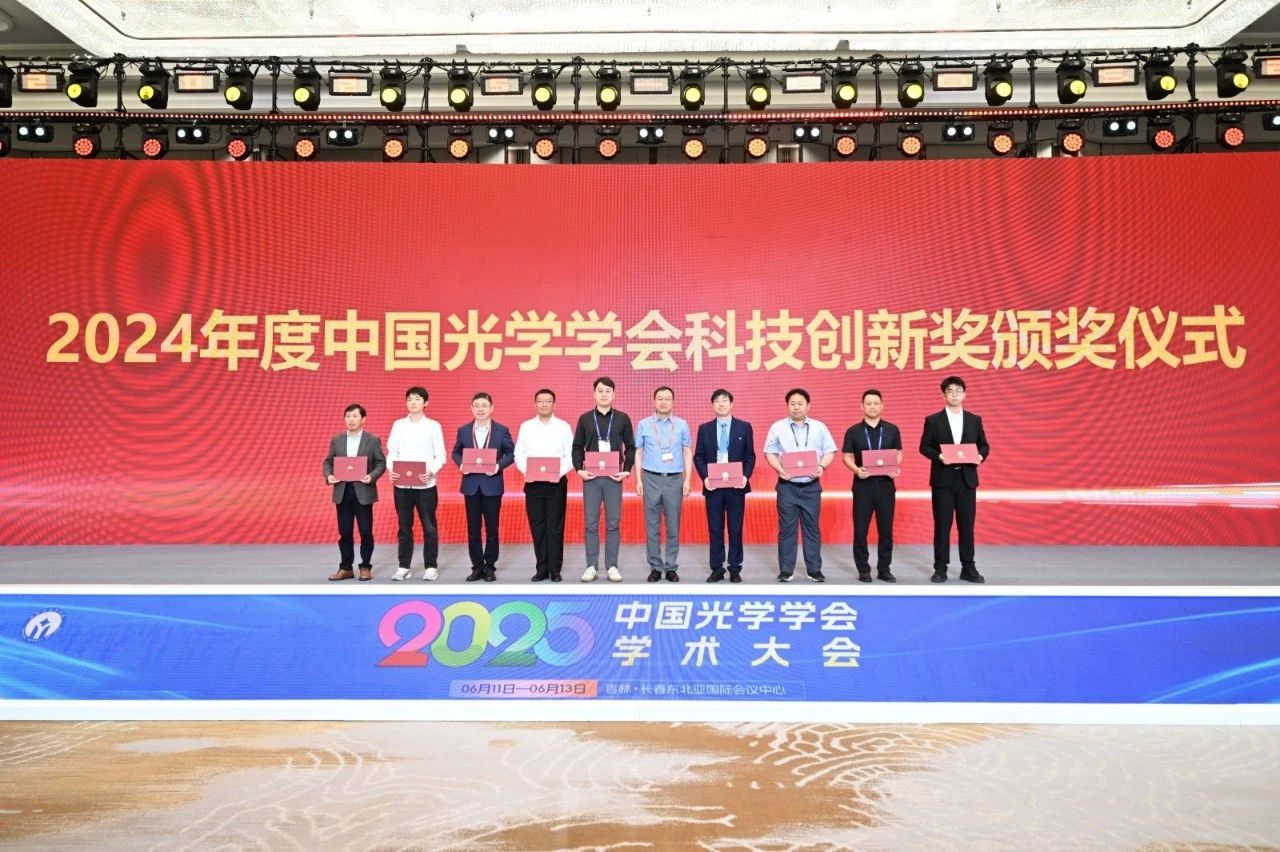
On June 11, 2025, the most authoritative and influential high-end academic event in China's optics and optoelectronics field—the Chinese Optical Society Academic Conference—opened in Changchun. Driven by the dual engines of “academia + industry” and “domestic + international,” this year's conference is dedicated to building a high-level platform for exchange among industry, academia, and research. It features 22 thematic tracks and nearly 100 sub-tracks spanning basic research to industrial application, fully demonstrating the breadth and depth of optical science and technology and the core value of industry-academia-research integration. More than 2,000 experts, scholars, and young students engaged in optics and optical engineering from universities, research institutes, and technology enterprises across the country attended the opening ceremony.
Professor Liu Xu, Secretary-General of the Chinese Optical Society and founder of Hangzhou Yuzhiquan Precision Instrument Co., Ltd., presided over the opening ceremony.
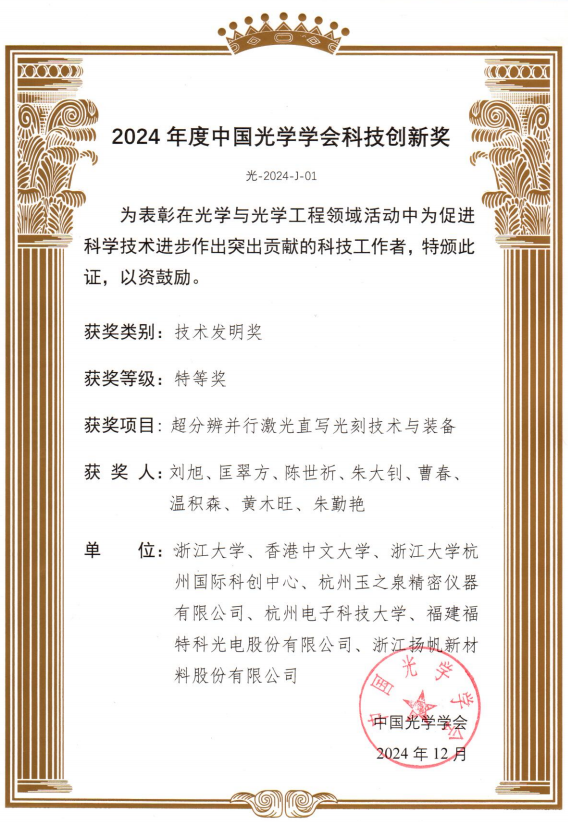
The opening ceremony included the presentation of plaques for science popularization education bases and the flag-awarding ceremony for student chapters, and presented several of the Society's major annual awards, including the Wang Daheng Optics Award, the Guo Guangcan Optics Award, and the Optical Science and Technology Innovation Award. Professor Kuang Cuifang, professor at the College of Optical Science and Engineering of Zhejiang University and founder of Hangzhou Yuzhiquan Precision Instrument Co., Ltd., took the stage on behalf of the winning unit to receive the “2024 Chinese Optical Society Science and Technology Innovation Award—Grand Prize”.
Award-winning technology:
Super-resolution parallel laser direct writing lithography technology and equipment
Technology overview:
The teams led by Professor Liu Xu and Professor Kuang Cuifang, together with Zhejiang University, Hangzhou Yuzhiquan Precision Instrument Co., Ltd., and other institutions, tackled the challenges of high-precision, high-throughput, and high-stability nanolithography and achieved three major breakthroughs:
1. A first-of-its-kind multi-channel synergistic suppression technology: by combining optical edge suppression with chemical material suppression, it breaks through the optical diffraction limit, achieving writing accuracy below 50nm with significantly improved stability.
2. A ten-thousand-beam parallel direct writing system: with independently developed core technologies such as high-throughput parallel direct writing, super-resolution focal spot modulation, beam stabilization, and focal plane tracking, it enables ten-thousand-channel parallel lithography and boosts efficiency a hundredfold.
3. Full-chain technological self-reliance: a complete technology system has been established, covering everything from optical design and control systems to dedicated photoresists.