

From July 22 to 26, 2025, the 3rd Conference on Advanced Imaging and Information Processing and the 2025 Annual Academic Meeting of the Holography and Optical Information Processing Committee of the Chinese Optical Society (AIIP2025) was grandly held in Kashgar, Xinjiang.
The conference was hosted by the Holography and Optical Information Processing Professional Committee of the Chinese Optical Society and Chinese Laser Press, and organized by the School of Physics and Electrical Engineering of Kashgar University and the Xinjiang Technical Institute of Physics and Chemistry, Chinese Academy of Sciences. It aimed to review the latest breakthroughs in advanced imaging, holographic technology, and optical information processing, promote exchange within the field through keynote presentations, analyze opportunities and challenges, assess development trends, and build a high-end platform to facilitate resource sharing and technology transfer, thereby enhancing China's competitiveness and international influence in this field.
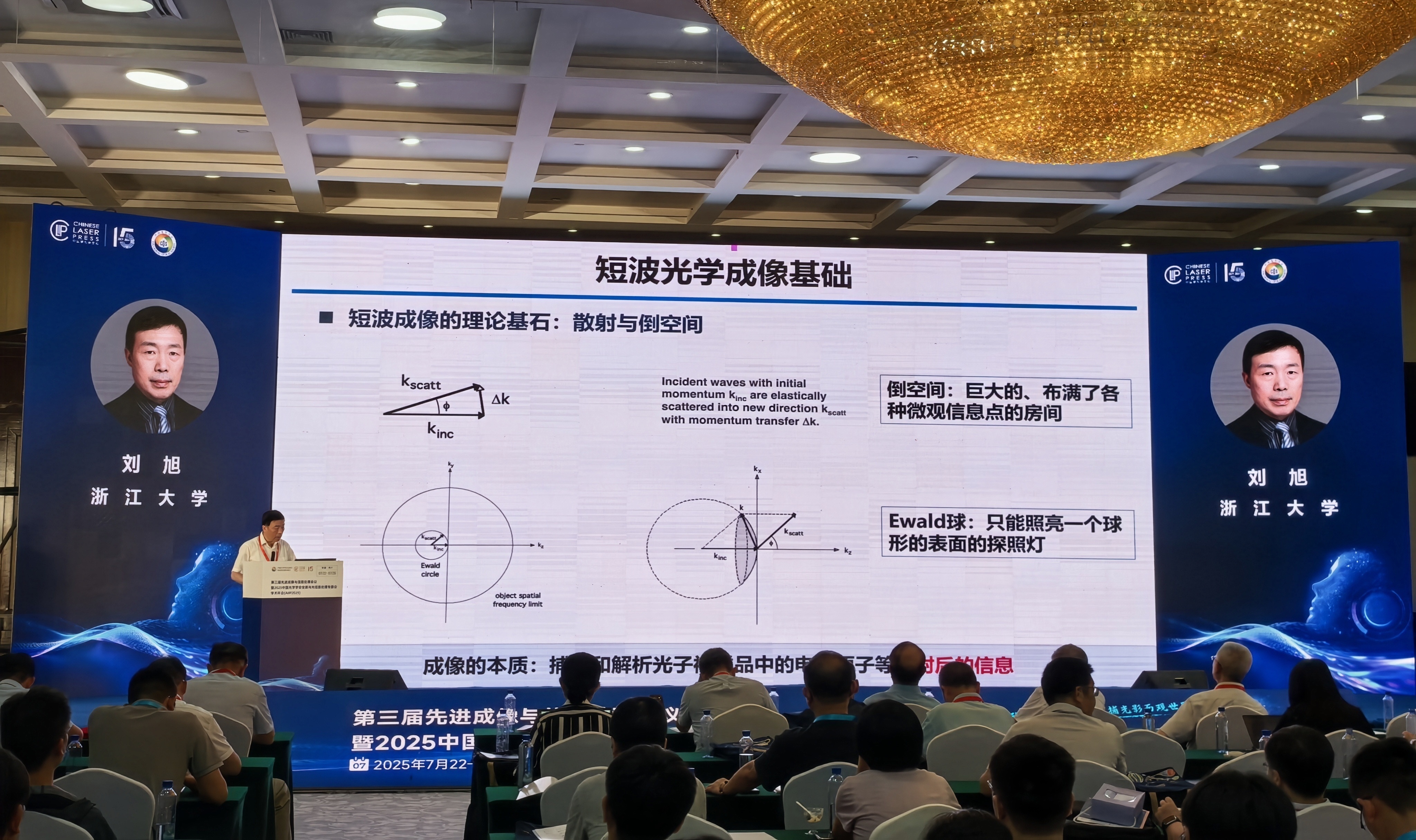
Professor Liu Xu of Zhejiang University, founder of Hangzhou Yuzhiquan Precision Instrument Co., Ltd., attended the conference as co-chair and delivered an invited presentation titled “Short-Wavelength Computational Diffraction Imaging Technology”. Given the urgent demand for ever-higher imaging resolution, the talk focused on the potentially central role of short-wavelength optics in ultra-high-resolution imaging.
At present, short-wavelength imaging faces two key challenges: first, efficient laboratory-scale short-wavelength light sources remain scarce; second, because short-wavelength light has a refractive index close to 1 in most media, conventional refractive optical elements are extremely difficult to fabricate and control. Addressing these challenges, Professor Liu Xu detailed his group's latest progress: in light source development, his laboratory has focused on extreme ultraviolet high-order harmonic generation, providing a viable laboratory solution for efficient short-wavelength imaging; in imaging methods, his group has delved into coherent diffraction imaging and ptychographic diffraction imaging, lensless approaches that effectively circumvent the bottleneck of fabricating short-wavelength optical elements and open new paths to high-resolution short-wavelength imaging.