

Introduction: A research team from the Department of Mechanical and Automation Engineering at The Chinese University of Hong Kong has recently developed a colloidal silver nanoparticle-assisted parallel femtosecond laser direct writing system, aiming to overcome the efficiency bottleneck in high-precision processing of transparent materials and to improve the fabrication efficiency of functional micro/nanostructures on the surfaces of glass and optical crystals. The work was published in 2025 in Laser & Photonics Reviews under the title "Colloidal Silver Nanoparticles-Assisted High-Precision Parallel Laser Writing on Glass and Optical Crystals."
Abstract: Transparent materials such as glass and optical crystals are essential components of modern optical systems because of their superior optical transparency, mechanical strength, and thermal stability. Although femtosecond laser direct writing is a widely used processing method, the high hardness and brittleness of these materials make high-quality processing challenging. By combining temporal focusing with colloidal silver nanoparticles, the authors propose a parallel ultrafast laser direct writing method that can efficiently produce high-quality, debris-free nanostructures on borosilicate glass surfaces. The results show that near-field enhancement by the silver nanoparticles enables precise material removal at a greatly reduced fluence (30% of the fluence in water), while bubbles generated in the liquid effectively remove debris. To demonstrate the flexibility and scalability of the method, various micro- and nanoscale structures were fabricated on glass surfaces, including one- and two-dimensional gratings with different periods and a centimeter-scale grating logo. Finally, the generality of the method was verified on fused silica glass and sapphire crystal substrates with comparable resolution. The approach could find important engineering applications, as it offers a high-throughput, high-resolution solution for fabricating functional surfaces or devices such as gratings, metasurfaces, and microfluidic channels on a variety of transparent materials.
The team exploited the localized electromagnetic field enhancement of silver nanoparticles (AgNPs) to reduce the ablation threshold energy to 30% of that required by conventional methods, breaking the energy-utilization bottleneck of low-absorption materials such as glass while reducing thermal damage. Laser excitation of AgNPs generates bubbles that strip away processing debris in real time through hydrodynamic action, enabling contamination-free nanostructures with high surface quality (gratings with a 700 nm linewidth) and dynamic debris removal by bubbles. Based on digital micromirror device (DMD) temporal focusing light-field modulation, the processing rate reaches 266 mm²/h—more than a hundred times faster—enabling parallel high-throughput processing. The method was also extended to high-hardness, high-brittleness materials such as sapphire crystals and borosilicate glass, providing a general solution for the scaled manufacturing of photonic chips, metasurfaces, and cross-scale devices.
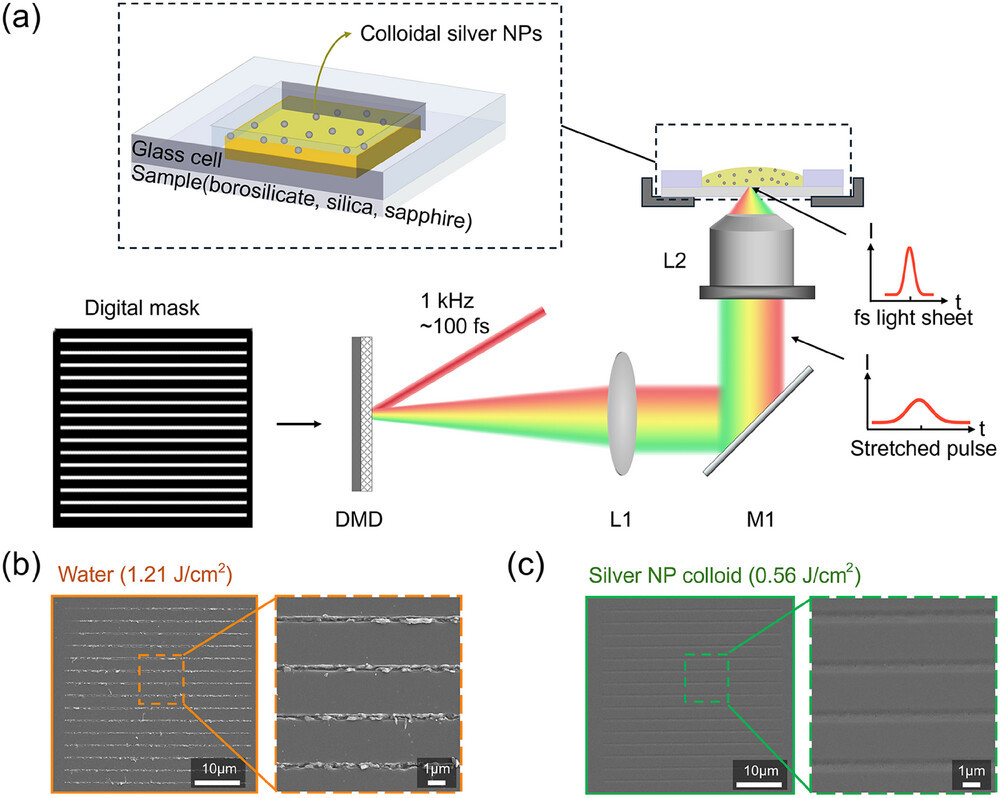
Figure 1 (a) Configuration of the femtosecond laser projection system used for AgNP-assisted parallel laser patterning. DMD: digital micromirror device (displaying the parallel nanogroove pattern); L1: collimating lens; M: mirror; L2: objective. SEM images of nanogrooves written by laser in (b) water and (c) AgNP colloid.
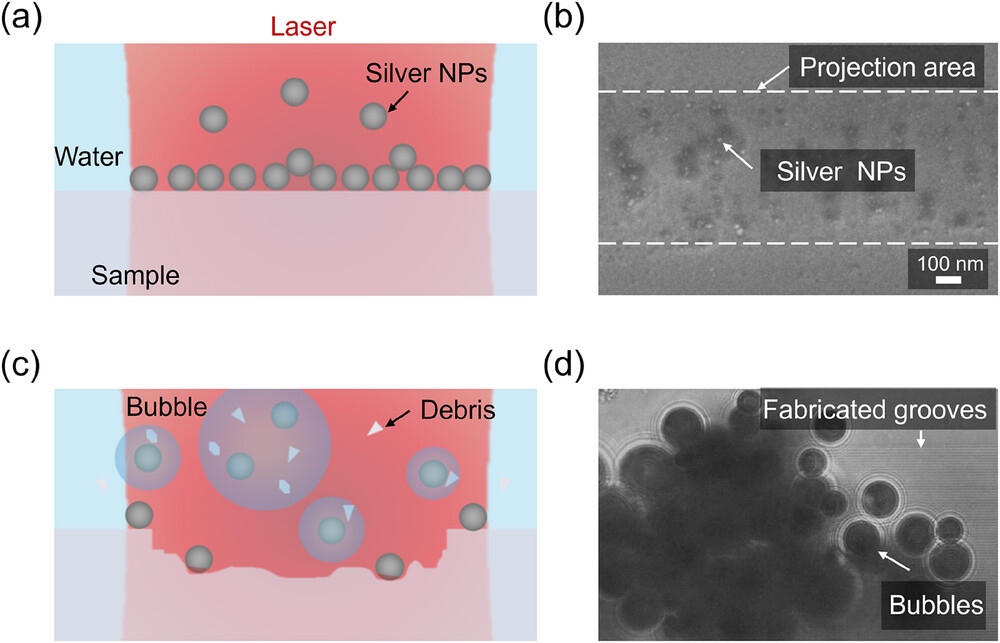
Figure 2 AgNP-assisted femtosecond parallel writing. (a) Deposition of AgNPs on the glass surface. (b) SEM image of AgNPs deposited on the glass surface. (c) Debris removal by bubbles formed through heating of the NPs. (d) Real-time optical images of bubble formation and debris removal during laser writing.
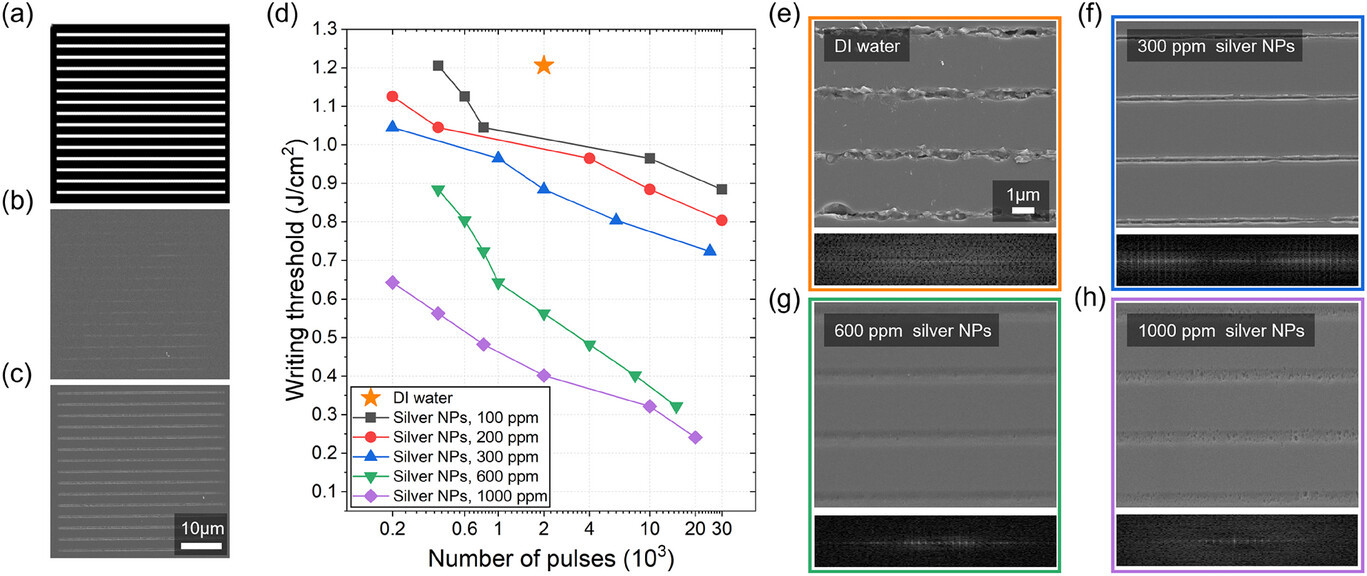
Figure 3 Writing quality and threshold of borosilicate glass under different AgNP concentrations and laser pulse numbers
(a) Stripe pattern on the DMD.
b, c) SEM images of fabricated lines below and above the writing threshold, (b) and (c) respectively.
(d) Writing threshold (laser fluence) as a function of laser pulse number for deionized water and AgNP colloids at different concentrations.
(e-h) SEM (top) and 2D-FFT (bottom) images of nanogrooves written with 2000 pulses in (e) water and in AgNP colloids at concentrations of (f) 300 ppm, (g) 600 ppm, and (h) 1000 ppm.
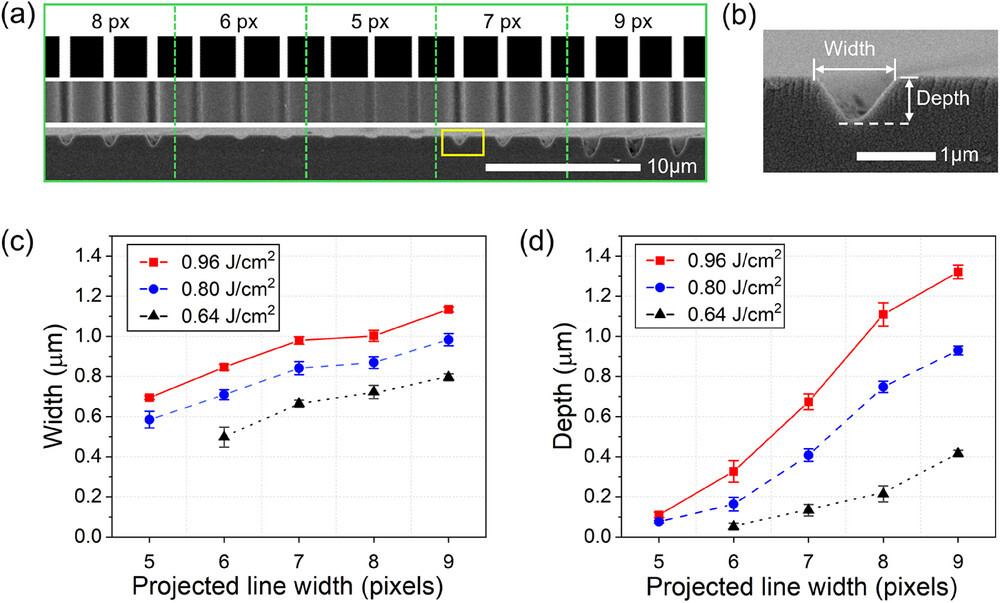
Figure 4 Laser fabrication of nanogrooves with different widths and depths on glass
(a) From left to right, parallel line patterns (i.e., nanogrooves) with linewidths of 8, 6, 5, 7, and 9 DMD pixels at a laser fluence of 0.96 Jcm-2 (top); top view of the nanogrooves (middle); and cross-sectional view of the nanogrooves (bottom).
(b) Schematic of groove width and depth measurement.
(c) Measured groove width and (d) depth as a function of the projected linewidth under different laser fluences.
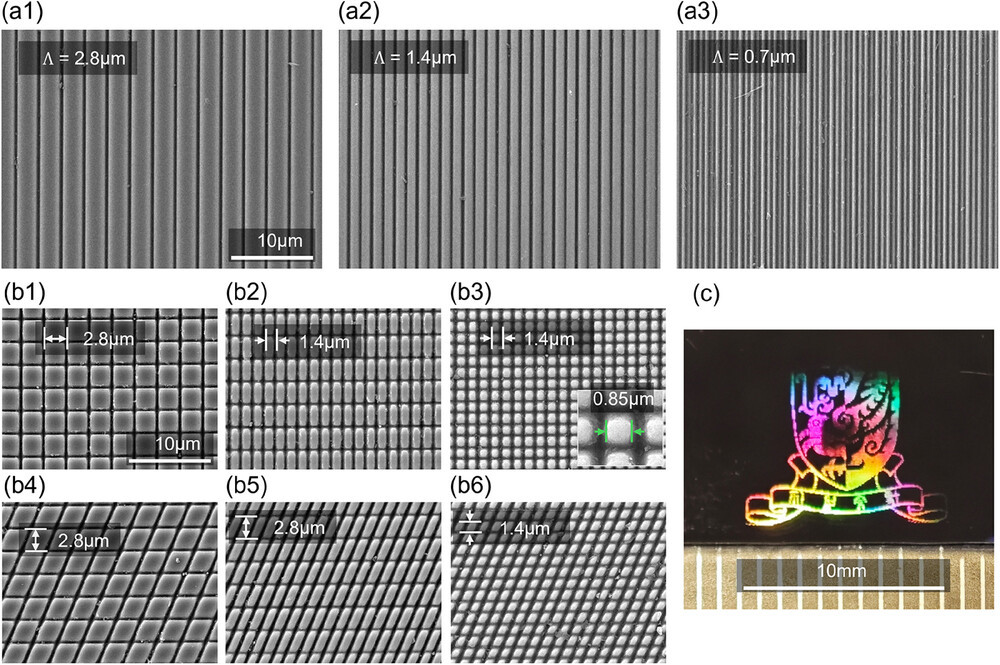
Figure 5 Fabrication of 1D and 2D gratings
(a1-a3) 1D gratings with different periods. From left to right, the periods are 2.8, 1.4, and 0.7 μm.
(b1-b6) 2D gratings with different periods and shapes.
(c) Optical image of a centimeter-scale "Zhongda" logo composed of 1D gratings with a period of 2.8 μm; the photograph was taken with the ruler at the bottom as a reference.
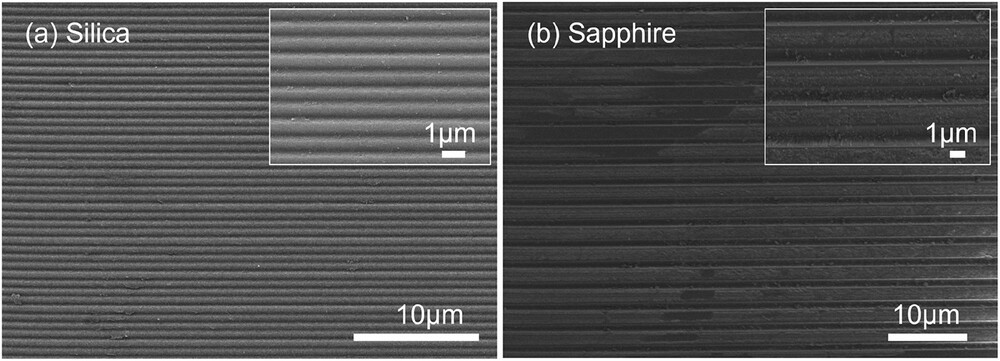
Figure 6 SEM images of nanogrooves fabricated on (a) fused silica glass and (b) sapphire crystal
This work proposes a temporal-focusing-based colloidal AgNP-assisted parallel laser fabrication method that produces complex 2D structures on different types of glass and crystals at sub-diffraction-limit levels while reducing fluence. The NP colloid enables near-field enhancement through bubble formation to precisely remove material and clear debris, significantly improving structure quality. In the experiments, the fabrication fluence and quality at different NP concentrations, as well as the minimum feature size and depth at different fluences and projected linewidths, were studied. 1D and 2D gratings with different periods and shapes were fabricated on borosilicate glass to verify the precision and uniformity of the projection method. In addition, 2D structures were prepared on fused silica glass and sapphire crystals to confirm the generality of the method. With the demonstrated precision, speed, and material versatility, colloidal NP-assisted projection fabrication may find important applications in precision laser manufacturing and advanced manufacturing, such as microfluidic devices, photonic devices, and integrated optical devices.
Source: Ye, Minxin, et al. "Colloidal Silver Nanoparticles-Assisted High-Precision Parallel Laser Writing on Glass and Optical Crystals." Laser & Photonics Reviews, 24 May 2025.
Article URL:https://onlinelibrary.wiley.com/doi/10.1002/lpor.202500047
DOI:10.1002/lpor.202500047