
To reflect the latest trends in optical information encryption and storage in a timely and comprehensive manner, Chinese Journal of Lasers published a special issue on "Multidimensional Optical Information Encryption and Storage Technologies" in issue 18 of 2023. (Click to view the special issue webpage)
The inside back cover article of the special issue comes from the research groups of Professors Xiao Shumin and Ruan Qifeng at Harbin Institute of Technology (Shenzhen). The article reviews the principles of two-photon polymerization lithography (TPL) 3D printing, several common structural-color 3D structures and printing schemes, and the research progress of TPL in structural color volumetric information and dynamic information applications, and concludes with an outlook on the field. (Click to view the original article)
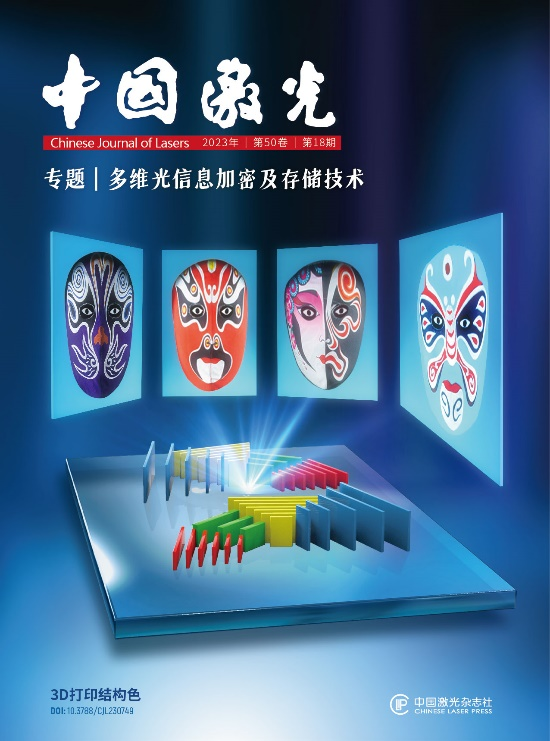
Su Sihua, Wang Kaiyang, Huang Can, Jin Limin, Xiao Shumin, Ruan Qifeng. Research progress in structural color based on two-photon polymerization 3D printing technology [J]. Chinese Journal of Lasers, 2023, 50(18): 1813007.
Cover interpretation
The cover borrows the Sichuan opera face mask, a treasure of Chinese culture, to present the principle of realizing multiple high-precision structural color patterns with micro/nano 3D printing. Just as Sichuan opera performers complete one face change after another with superb skill in a single gesture, angle-multiplexed gratings fabricated by two-photon polymerization 3D printing can perform a "face change" in micro/nano optics: under obliquely incident white light, a slight rotation of the sample reveals rapidly switching sets of colored micropatterns through the microscope. Multiple/dynamic structural color based on two-photon polymerization 3D printing has important applications in optical anti-counterfeiting, information storage, and optical sensing.
1. Introduction
From the elegance of a peacock's display to the shimmering colors of butterfly wings, nature is full of "color masters." Similarly, with 3D printing technology and optical principles, researchers can gently adjust specially printed samples under white light incident at different angles to present a "flowing" understated brilliance and ever-changing, chameleon-like colors.
The 3D printing process can be compared to making sugar painting. A sugar painting artist first envisions the model, then solidifies warm syrup layer by layer on a flat surface to form a three-dimensional object with varying heights. Current 3D printing technologies mainly include fused deposition modeling (FDM), direct ink writing (DIW), resonant laser printing (RLP), stereolithography (SLA), and digital light processing (DLP). However, these technologies have difficulties in fabricating 3D structures at the submicron scale. Two-photon polymerization lithography (TPL) can easily print polymer structures with submicron precision and is one of the highest-precision 3D printing processes available today.
This article briefly reviews the principles of TPL 3D printing, several common structural-color 3D structures and printing schemes, and the research progress of TPL in structural color volumetric information and dynamic information applications, and concludes with an outlook on the field.
2. Principles of two-photon polymerization 3D printing
Two-photon absorption (TPA) is a third-order nonlinear optical effect, referring to the process in which a molecule simultaneously absorbs two photons when transitioning from the ground state to an excited state. TPL uses a femtosecond laser to excite the initiator in the photoresist; after absorbing two photons, the initiator induces molecular polymerization. Owing to the threshold characteristic of two-photon polymerization, polymerization of the photoresist is confined to the femtosecond laser focus, resulting in extremely high processing precision. The minimum linewidth of TPL-printed structures can be less than 100 nm.
In a TPL printing system, galvanometer mirrors and an optical shutter are used to scan the focused beam point by point and layer by layer to print complex structures. Printing systems can generally be divided into immersion (left, Figure 1) or oil-immersion (right, Figure 1) configurations. The advantage of the immersion configuration is that it can fabricate 3D structures with larger heights (several millimeters). To optimize printing precision, the refractive index of the photoresist used should match the numerical aperture of the objective. The oil-immersion configuration prevents the objective from being contaminated by the photoresist, but the printing height is limited by the working distance of the objective.
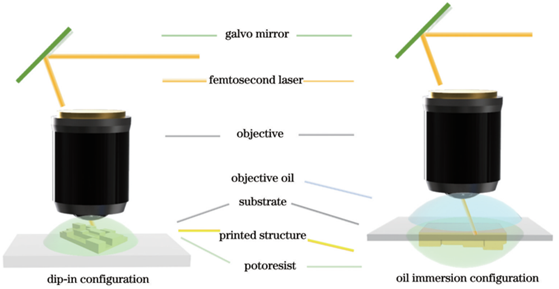
Figure 1 Immersion (left) and oil-immersion (right) configurations of the two-photon polymerization 3D printing process
Compared with other planar micro/nano fabrication technologies, the key advantage of TPL is its ability to fabricate high-precision true 3D structures. In addition, by using photoresists that respond to external stimuli, TPL can also create 4D micro/nanostructures whose shape and properties change over time (with time as the fourth dimension).
3. Structural color
In daily life, the colors we observe come from luminous or non-luminous objects. For non-luminous objects, the origin of color can be divided into two main types: one is that the object absorbs part of the incident light while reflecting or transmitting the rest, which can be called pigment color [Figure 2(a)]. The face masks of Sichuan opera performers, carefully painted with a variety of colored pigments, are a vivid example of pigment color. The other type is color produced by the interaction of light with micro/nanoscale structures, known as structural color.
Structural color originates from the interaction of light with micro/nanostructures, such as interference, diffraction, and scattering. The colorful soap bubbles we commonly see are multicolored structural colors produced by thin-film interference [Figure 2(b)]. By adjusting the geometric parameters of the structure (such as period, size, shape, and surrounding environment), its optical response in the visible spectrum can be changed, producing a rich variety of colors.
The team of Xiao Shumin at Harbin Institute of Technology (Shenzhen) used silicon metasurfaces combined with a refractive-index-matching layer to produce highly saturated structural colors. By fabricating silicon nanostructures of varying sizes pixel by pixel, they successfully demonstrated a vivid "peacock and orchid" color micro-image [Figure 2(c)]. Compared with conventional dyes and pigments, structural color is favored for its environmental friendliness, resistance to fading, and extremely high printing resolution, making it a hot topic in micro/nano optics research.
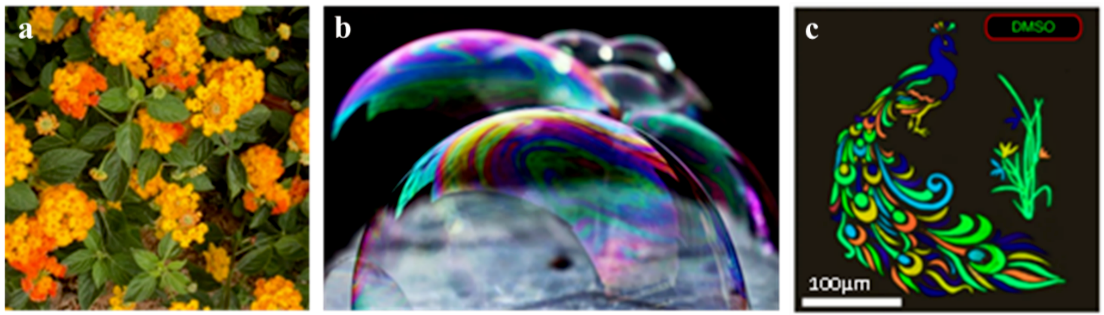
Figure 2 Colors of non-luminous objects: (a) pigment color of a flower; (b) structural color of soap bubbles (from Pixabay); (c) high-precision, high-saturation structural color images fabricated at the micro/nano scale (from Nature Communications, 2020, 11: 1864)
4. Multiple/volumetric information in structural color
After realizing the storage of two-dimensional image information such as photographs, people began to use angular information to achieve volumetric imaging. Researchers have now begun to explore the fabrication of 3D structural color samples and methods for presenting colored volumetric information. Assembling nanospheres into an opal structure is a relatively simple micro/nano fabrication process and is often used to prepare large-area uniform structural color.
On this basis, researchers used the nanosphere-assembled opal structure as a template, used TPL to selectively cure the photoresist between some of the spheres, and removed the template after development to create complex 3D structural color samples [Figure 3(a)]. By changing the size of the nanospheres, inverse opal structures with bright colors, high reflectivity, and narrow stopbands can be produced. By editing information on different planes, different colored characters can be read separately from multiple focal planes [Figure 3(b)].
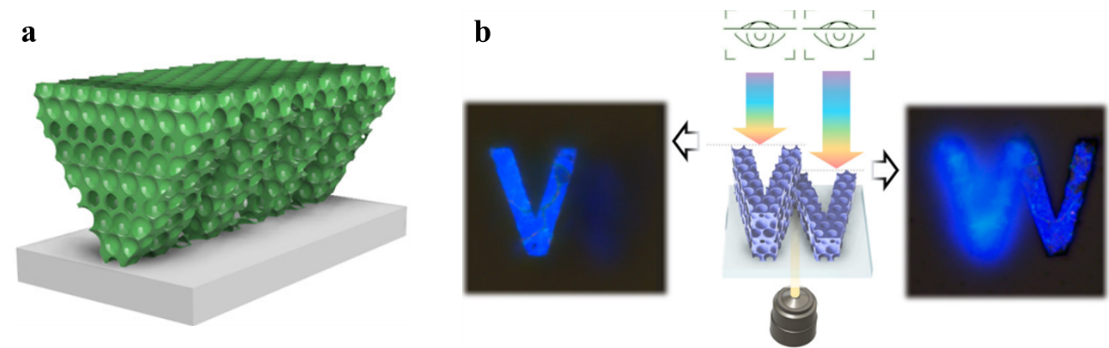
Figure 3 Structural color realized by inverse opal structures: (a) 3D inverse opal structure model (from Nano Letters, 2021, 21: 8602); (b) different colored characters read separately from multiple focal planes (from Nano Letters, 2021, 21: 8602)
Joel Yang of the Singapore University of Technology and Design, together with Ruan Qifeng of Harbin Institute of Technology (Shenzhen) and others, used special optical designs to present multiple sets of volumetric structural color information. By decoupling the influence of grating height and period on structural color, the team made TPL-printed samples display different color images under normal and oblique incidence illumination. Furthermore, by exploiting the directional effect of angle-multiplexed gratings, multiple cartoon color images can be displayed in sequence as the sample is rotated [Figure 4(a)].
In addition, the team used TPL to print, in a single step, a castle structure combining microlenses and nanopillars, creating a high-resolution light-field print. In this system, incident light passes through structural color nanopillar pixels and is then collected by the microlens and projected to the observer, who can see the color of the selected pixel with the naked eye. By designing structural color nanopillars at different positions under each lens according to light-field display principles, 3D color cartoon faces with 25 or even 625 viewpoints can be realized [Figure 4(b)]. These nanopillars, which store color information, are hidden inside the castle structure and cannot be directly replicated by template methods, giving them high anti-counterfeiting performance.
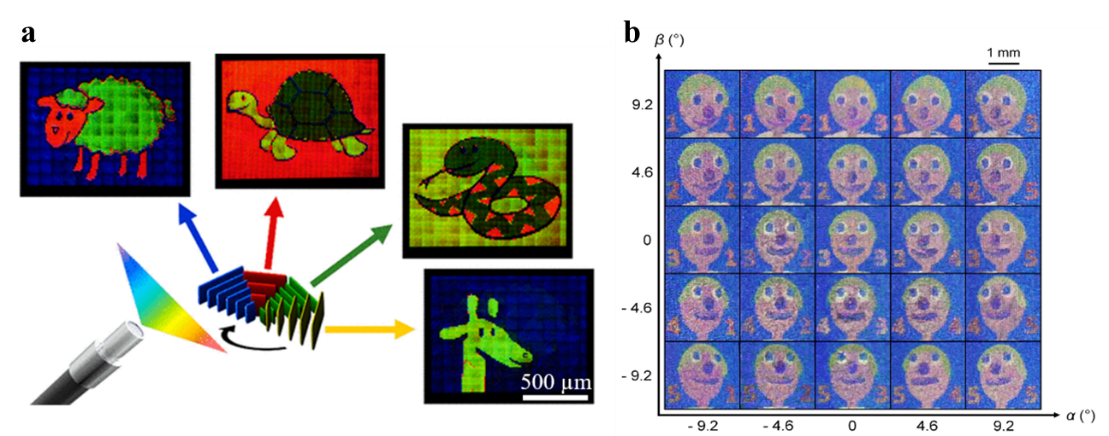
Figure 4 (a) Multiple/volumetric structural color information presented by combining illumination conditions (from Nano Letters, 2022, 22: 8189) or (b) using the light-field display principle (from Nature Communications, 2021, 12: 3728)
5. Dynamic structural color information
Reversible tuning of 3D-printed structural color is mainly achieved through external stimuli, including but not limited to humidity changes, temperature changes, pH, mechanical strain, light, magnetic fields, and voltage bias.
For example, researchers successfully fabricated surface-relief elastomers using TPL printing and replica molding, and applied groove structures capable of carrying dynamic structural color to encrypt multiple sets of optical information (Figure 5). By applying stress in different directions, the structural color of the grooves changes reversibly and repeatably. Unlike conventional Bragg diffraction gratings that require large-area periodic arrays, this work can produce rich structural colors with a single groove.
Based on the unique color-change behavior of flexible grooves, various schemes for dynamically tuning structural color can be designed. Through coordinated control of directional strain and capillary forces, an integrated elastomer with six different patterns can be achieved [Figure 5(a)].
In addition, they designed and fabricated relief samples with interleaved nanogroove structures; when the elastomer is stretched in orthogonal directions, the originally transparent regions successively display images of a tree and a flower [Figure 5(b)]. These micro/nanostructures with cyclically tunable shape/color have important application value in anti-counterfeiting, information storage, and strain sensing.
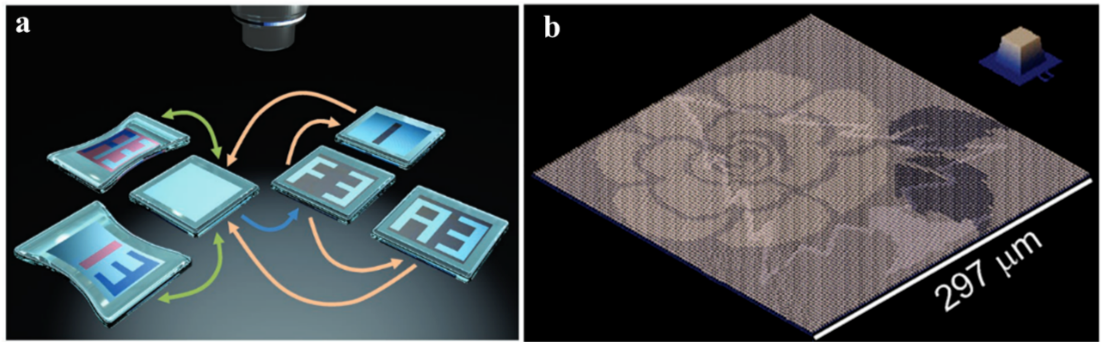
Figure 5 Surface-relief elastomers for presenting dynamic structural color information. (a) Schematic of the integrated elastomer (from Advanced Materials, 2022, 34: 2108128); (b) Schematics of the designed flower and tree (from Advanced Materials, 2022, 34: 2108128)
6. Summary and outlook
Two-photon polymerization lithography provides abundant design freedom for micro/nano fabrication and brings new possibilities for structural color applications. Although TPL-based 3D structural color printing has made initial progress, its potential has not yet been fully explored.
At present, the low processing efficiency of this technology in industrial production remains a problem that requires further improvement and optimization. Future work could also explore schemes for manipulating more degrees of freedom of light with TPL. In summary, TPL micro/nano 3D printing has broad application prospects in optics. Through continued research and exploration, we can further develop and optimize this technology, promote its application in scientific research and industrial production, and achieve more far-reaching progress in optical communication, optical encryption, and data storage.
About the research group
The research group of Ruan Qifeng at Harbin Institute of Technology (Shenzhen) (http://faculty.hitsz.edu.cn/ruanqifeng) focuses on micro/nano optics and micro/nano manufacturing. The group's Micro/Nano Photonics Laboratory is an important part of the MIIT Key Laboratory of Micro-Nano Optoelectronic Information System Theory and Technology and the Guangdong Provincial Key Laboratory of Semiconductor Materials and Intelligent Photonic Systems. The group has long been engaged in multidisciplinary basic and applied research in micro/nano optics, including physics, materials science, and micro/nano fabrication, and has a complete platform for micro/nanostructure design, fabrication, and testing. Students and scholars interested in related fields are welcome to join.
About the journal:
Founded in 1974, Chinese Journal of Lasers is supervised by the Chinese Academy of Sciences, sponsored by the Shanghai Institute of Optics and Fine Mechanics, Chinese Academy of Sciences, and the Chinese Optical Society, and published by the Chinese Laser Press. It is a flagship Chinese-language academic journal that comprehensively reports the latest research results in laser technology. In 2021 it became a semimonthly and began publishing "extended English abstracts" to enhance the international reach of its papers. In 2021 and 2022 it launched special issues on "Frontier Laser Manufacturing" and "Biomedical Photonics," respectively.
Chinese Journal of Lasers is currently indexed by EI, ESCI, AJ, CA, INSPEC, Scopus, CSCD, and other databases. It has repeatedly been recognized as one of the "Top 100 Science and Technology Journals," "Top 100 Outstanding Academic Journals of China," "China Fine Sci-Tech Journals," and "China's Most Influential Academic Journals." In 2019 it was selected for the "Excellence Action Plan for Chinese Sci-Tech Journals." In 2021 it received a nomination for the Journal Award of the "Fifth China Publishing Government Award." In 2022 it was listed as "T1" in the Classification Catalogue of High-Quality Sci-Tech Journals in Optical Engineering and Optics.
Scientific editors | Professor Ruan Qifeng and Su Sihua, Harbin Institute of Technology (Shenzhen)
Editor | Shen Lingling